Rays, waves, polarisation
Dispersion, Fresnel reflection, interference, and full Stokes-vector polarisation — not a simplified subset of one.
Photonica / spectral optics bench
Photonica is a native GPU optics bench. Build a laser, drop in real glass, aim it at a screen — every ray carries a wavelength, every measurement is a real number, and the light in flight is slow enough to watch arrive.
Windows 10/11 · an RTX-class GPU (DirectX Raytracing 1.1) · free.
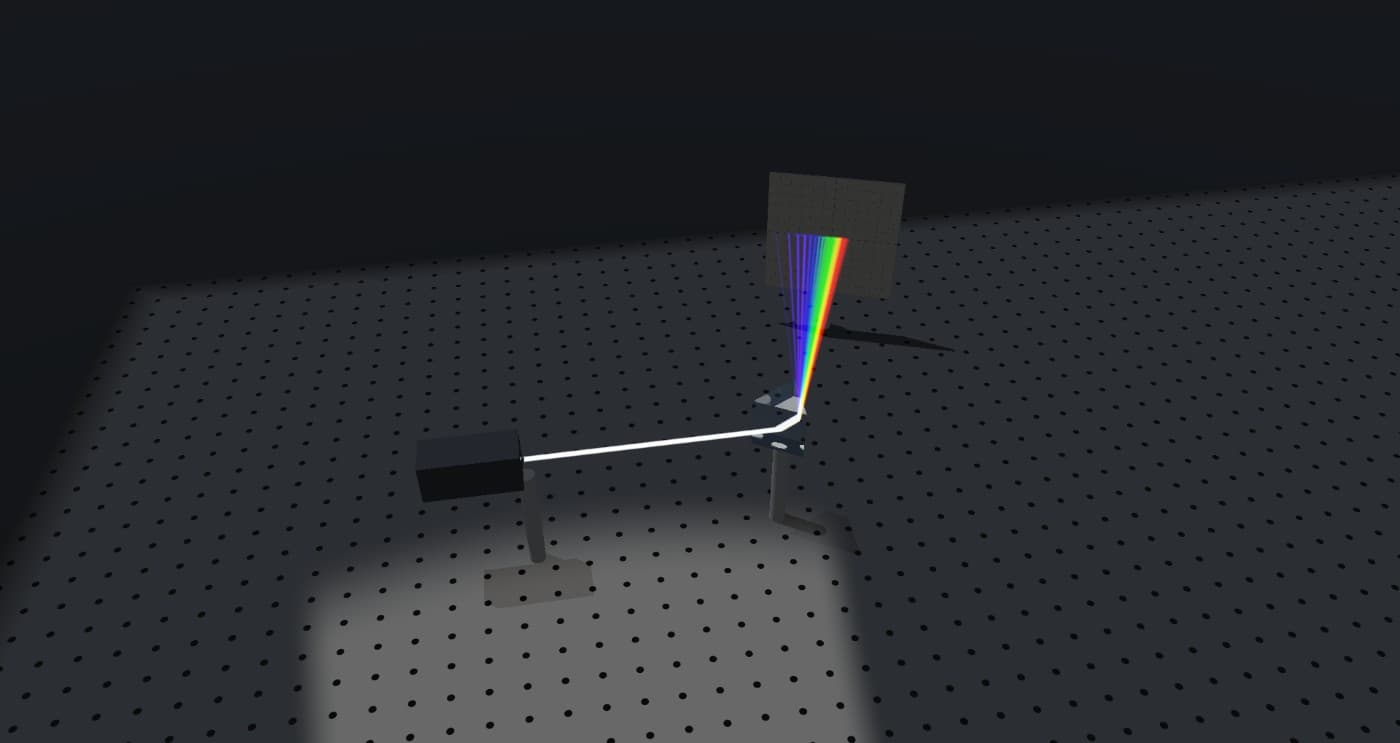
Most optics toys draw pretty rainbows
A glass in Photonica isn't a colour — it's Sellmeier dispersion data, the same curves a real optics catalogue ships. So we ran 33 textbook experiments through it: Snell's law, Fresnel reflectance, Brewster's angle, the lensmaker equation, achromatic doublets, diffraction gratings, telescope magnification — each compared to its closed-form answer, not eyeballed.
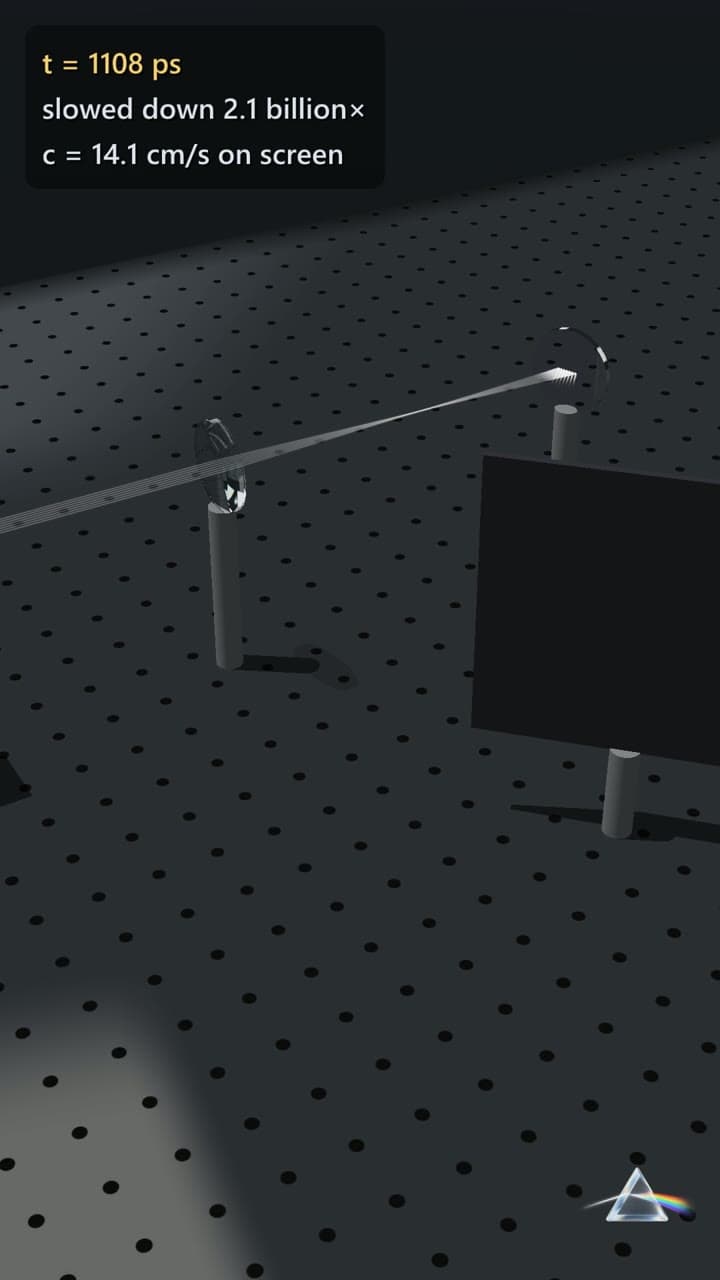
Light doesn't arrive instantly
Every ray carries a real arrival time. Slow the pulse down two billion times and you can watch it cross a prism, refract, and land on a screen — with the screen staying dark until the light has actually reached it, not before.
See it on a real bench ↗Dispersion, Fresnel reflection, interference, and full Stokes-vector polarisation — not a simplified subset of one.
A damped least-squares optimiser and Monte-Carlo tolerancing turn a rough lens sketch into a buildable design.
An MCP interface lets an AI build a bench, take a measurement, and check its own result — the same interface the validation suite used.
The honest bit
Photonica ray traces every photon in real time, so it needs a DirectX Raytracing 1.1 GPU — RTX-class NVIDIA, AMD RX 6000-series or newer, or Intel Arc. Most laptops without a dedicated GPU can't run it yet, and we'd rather say that plainly than ship something that fakes the light to get around it. Everything else here — the physics, the tolerancing, where this is going — we're building for real, not for a demo.
Get Photonica